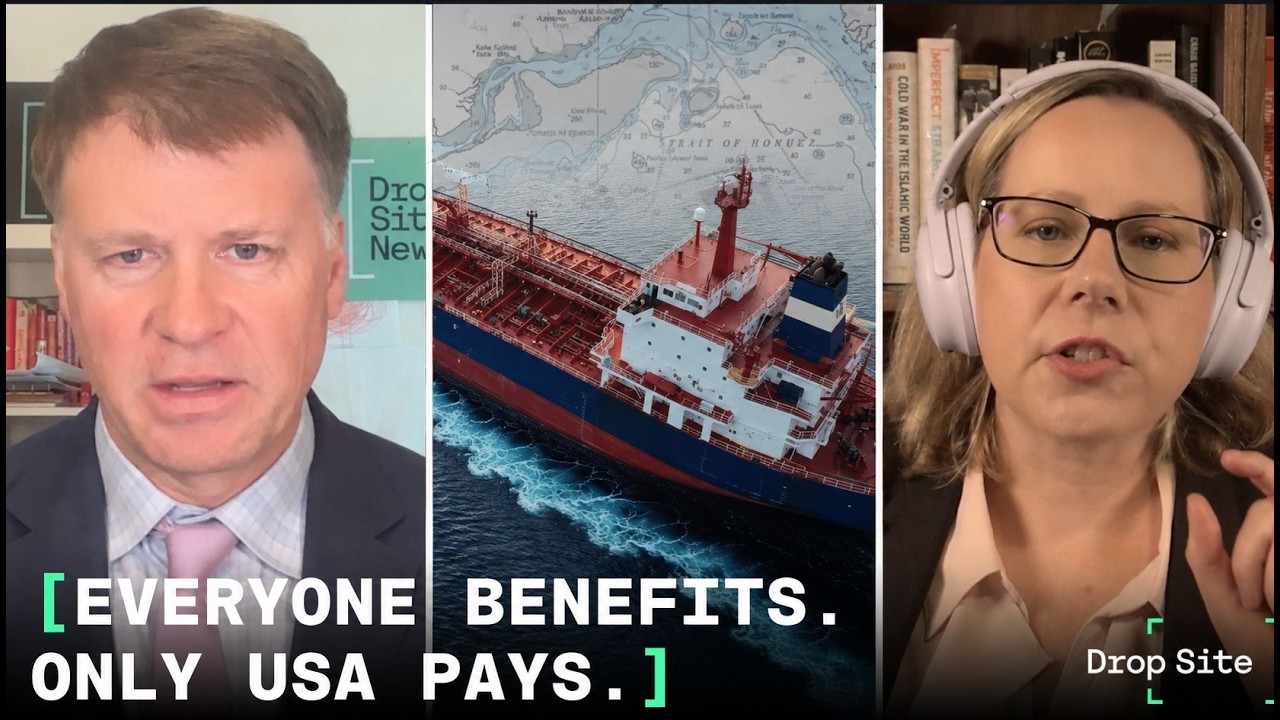
Defense analyst argues U.S. should accept Iranian toll system for Strait of Hormuz transit
Rosemary Kelanic, director of the Middle East Program at Defense Priorities and author of "Black Gold and Blackmail," argues in analysis that the U.S. should stop spending tens of billions of dollars annually to guarantee free oil transit through the Strait of Hormuz and instead accept an Iranian-Omani toll system. According to the analysis, the current U.S. military commitment risks American lives while subsidizing global oil markets. The discussion, hosted by Drop Site News's Ryan Grim, also examines why oil markets have avoided collapse amid ongoing regional tensions.
🧭 In Context
According to Drop Site News, Kelanic's argument enters an ongoing debate about U.S. military spending in the Middle East and the sustainability of American naval commitments to global commerce. The New York Times publication of her essay (confirmed by the video description) indicates the argument has reached mainstream editorial platforms. The source notes that oil markets have historically avoided collapse, which Kelanic frames as evidence that a toll-based system would not destabilize global energy supplies.
📹 Source Video
What we know
- ✓Oil markets have historically avoided collapse, per the video description's reference to Kelanic's discussion of market stability. (Drop Site News)
What remains unclear
- ?The specific amount of current U.S. annual spending on Strait of Hormuz operations is not quantified in the available source material.
- ?Details of the proposed Iranian-Omani toll system structure and pricing are not described in the source data provided.
- ?How mainstream policy institutions and the U.S. government have responded to Kelanic's specific proposal remains unclear from this source.
- ?The full scope of oil market impacts under a toll-based system versus current free-transit arrangements has not been detailed in the source material.
This item is classified as Analysis. Claims reflect the source's arguments and policy position, not independently verified findings. The source is a recognized policy analyst with institutional affiliation, and her New York Times publication confirms the essay exists and has reached mainstream platforms.
✓ Verified
- ✓Rosemary Kelanic is director of the Middle East Program at Defense Priorities. (Drop Site News)
- ✓Kelanic is author of 'Black Gold and Blackmail.' (Drop Site News)
- ✓Kelanic published an essay in The New York Times titled 'Let Iran Control the Strait of Hormuz.' (Drop Site News)
- ✓72 mainstream media articles have covered related topics. (Metadata)
~ Interpretation
- ~The U.S. spends tens of billions of dollars to guarantee free oil transit in the Strait of Hormuz. (Kelanic's argument, not independently verified)
- ~The current arrangement risks American lives. (Kelanic's characterization)
- ~An Iranian-Omani toll system would be preferable to the current U.S. military commitment. (Kelanic's policy argument)
- ~Oil markets have avoided collapse under current arrangements. (Kelanic's observation, context for her argument)
▸▾Why this is here
Learn about our confidence system → · What qualifies a story →
Stay with this story
Response links are not endorsements. They are restrained ways to learn more, track updates, and ask better questions.
Share responsibly
Share the story with context, not outrage. Include what is known and what remains unclear.
Eligibility: Geopolitical conflict is limited to learning, tracking, and careful sharing. View taxonomy →
Did this feel useful, agenda-driven, or unclear?
Get stories like this every morning.
Free daily briefing, 5 minutes, no spin.
Free. No spam. Unsubscribe anytime.